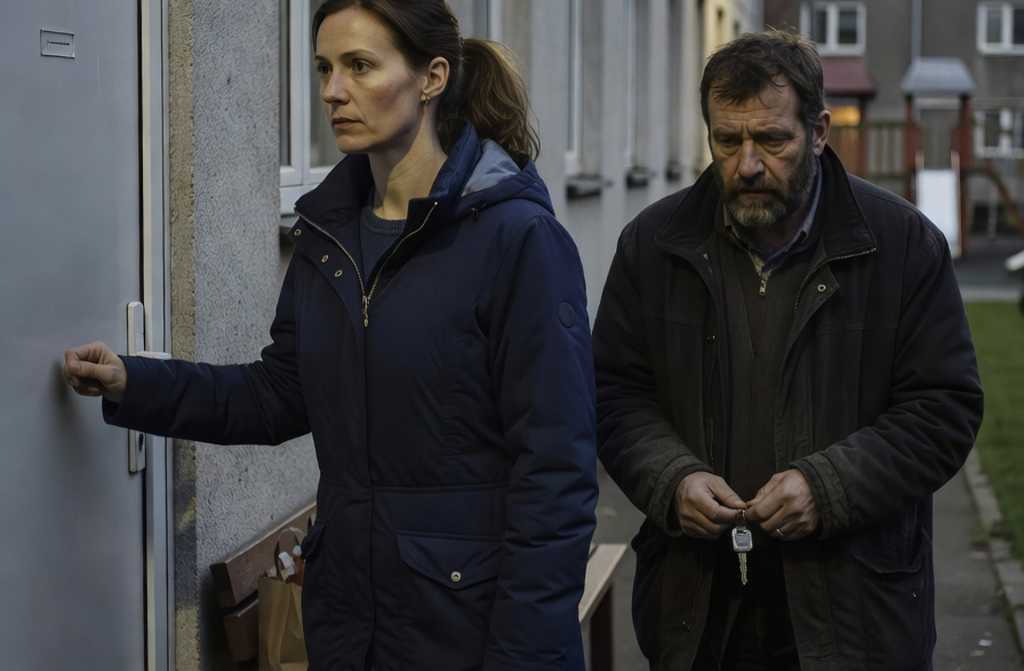
It was many years ago now, but the memory still lingers clearly in the mind. Emily stood outside the entrance to her new home, a plain concrete block of flats in a quiet suburban neighbourhood, nothing distinctive among the rows of similar buildings. She had just got back from work, the bag of groceries hanging from her hand in a way that spoke of the ordinary comfort of home she had been reaching for in those days.
The evening was cool. Emily shivered and pulled her coat more tightly around her. A gentle breeze tugged at the loose strands of hair from her untidy ponytail, and a faint flush coloured her cheeks from the chill. She was reaching for the intercom when she spotted James.
He stood a few paces away, seeming unsure whether to come any closer. His hands gripped the car keys tightly, that same silver key fob she had chosen for him one birthday. Everything about his stance showed how uneasy he felt: shoulders stiff, fingers turning the keys over and over, eyes darting across her face as though searching for answers before she could give them.
“Emily, please hear me out,” he said, his voice softer and more hesitant than usual. He edged forward a little but stopped at once, as if worried he might frighten her off. “I’ve thought it through. Let’s try again. I… I got it wrong.”
Emily let out a slow breath. She had heard these words before, at different times in their years together, always leading to the same place. Fine speeches were followed by the old patterns, the same slips, fresh wounds. She met his gaze steadily, showing no sign of distress.
“James, we’ve been over this. I’m not coming back.”
He moved nearer, almost touching her. His eyes held a desperate hope, as though he truly thought this time she might relent.
“But look how it’s turned out!” His voice shook. “Without you… everything’s coming apart. I can’t manage!”
Emily watched him without speaking. The street light fell gently on his face, and she saw for the first time the changes that had come over the past six months. Lines had deepened around his eyes that she had not noticed before. His beard, once neatly kept, now looked rough, as if he had stopped caring for his appearance. And his eyes carried a weariness she had not seen in all the fifteen years they had shared.
James took one more step, closing the space between them. A pleading tone entered his voice.
“Let’s begin again. I’ll buy a flat. The one you wanted. And a car, the sort you dreamed about. Just come back…”
For a brief moment something inside Emily shifted. There was such honesty in the way he spoke, such real longing in his eyes to put things right, that she almost believed him. Yet the feeling faded quickly. She ran through the list of earlier promises in her mind, grand and heartfelt but never more than talk. How often he had sworn he would change, how often he had vowed to start fresh… and each time things slipped back to where they had been.
“No, James,” she said firmly. “My mind is made up. I won’t change it. You sent me away, you treated me as though I was nothing… I’ll never forgive you.”
Emily sighed softly and set the bag of groceries down on the wooden bench beside the entrance. The air was growing colder, so she fastened her coat once more, more securely this time.
“Don’t you see it, James?” Her voice stayed calm, though the firmness remained. “It’s not the flat or the car that matters.”
James started to speak, but Emily lifted a hand to quiet him. He paused, swallowed, and gave a small nod to show he would listen.
“Think back to how we began,” she said, her eyes turning distant as though she looked past him into earlier times. Her gaze narrowed a little, as if trying to make out those distant days through the haze of years.
She waited a moment to gather herself before going on.
“We were young and full of hope. You worked at a building firm, and I had only just started as a teacher in the primary school. We rented a small flat, cramped but cosy enough for us. Money was short; at times we counted every penny until payday, yet we kept our spirits up. We made meals side by side, laughed at our mistakes, and talked about what lay ahead. We pictured having children, pushing a pram through the park, and setting out as a family for the start of the new school year…”
James nodded without a word. That time stayed with him as one of the happiest stretches he had known. Anything seemed within reach then. Every difficulty felt like a passing hurdle they could clear together. He thought of that first rented flat, the narrow kitchen, the squeaking sofa, the tap that dripped no matter what they did until they moved. He recalled sitting on the floor, eating pizza straight from the box, and laying out plans with the sure belief that all would fall into place.
“Then the girls arrived,” Emily’s voice softened, though a trace of sadness crept in. “First Olivia, then Sophia five years later. You were so pleased, so proud. I remember you holding Olivia in the hospital, looking overwhelmed and joyful all at once. When Sophia came, you brought a large bunch of roses and a cake, even though the doctors had warned against anything sweet…”
She gave a small smile, but it carried a touch of sorrow, as though the memory brought both warmth and ache.
“After that, things shifted,” she went on, her tone growing steady again. “You began to earn more, bought the larger flat in the new development, got the car… Life looked different. You became the provider, the man in charge. And I… I was simply the wife who ‘did nothing’. Do you recall saying once, ‘You stay at home while I’m out working my fingers to the bone’? You never saw what lay behind that ‘staying at home’: the nights without sleep when the children were ill, the school gatherings, the clubs and extra lessons, the washing, the cleaning, the cooking… all the things you dismissed as not counting for work.”
Emily stopped and studied James. Her eyes held no anger, only tiredness and a quiet sorrow from someone who had spent years trying to make a point that had gone unheard.
James opened his mouth, ready to defend himself, but Emily raised her hand once more. Her look was steady, yet it showed she meant to finish what she had started.
“Don’t cut in, please,” she said, speaking a little louder to be sure he caught every word. “I held my tongue for too long and put up with it. You often claimed I was never satisfied, that I picked fights over trifles. But why did it happen that way? Because I was trying to reach you. I wanted to show that the girls needed more than toys or holidays by the sea; they needed attention, rules, and limits. Love isn’t only about giving them what they ask for; it’s knowing when to say no.”
She paused briefly to let the words settle, then slowed her pace a little as she continued.
“You always gave way to them. Remember how Olivia, when she was small, would come running with tears in her eyes saying, ‘Daddy, I want a new tablet!’ and within the hour it would be hers? Or how Sophia, a bit older, would announce, ‘Daddy, I don’t feel like homework!’ and you would let it slide until the next day because ‘she’s tired and needs a break’?”
James lowered his head without meaning to. Those moments rose up at once, sharp as if they had just passed. He could see the girls hugging his neck and telling him he was the best father, their faces bright with delight over each new thing. It had felt right then, making up for the hours he spent away at work. Emily would frown and speak of discipline and what might follow, but he would brush it aside: “Let them enjoy being young while they can! Troubles will come soon enough.”
“And when I tried to guide them,” Emily’s voice dropped but kept its resolve, “you shouted that I was ‘being cruel to the children’, that I was ‘heartless’. You told me not to raise my voice, said it would harm them, that I ought to be a gentle mother instead of a strict one.”
She shook her head, the gesture full of weariness rather than fury, the weariness of someone who had explained the same thing over and over without being understood.
“And this is what came of it,” she said, meeting his eyes directly. “At eight and thirteen they leave their things lying about, they have no sense of what is not allowed, and they take everything for granted because they have always had it at once. They do not know how to look after what they own or that time is precious or that actions have consequences. When I try to bring in even a few rules, they run to you saying, ‘Dad, Mum’s cross again!’ and you step in at once, telling them I am in the wrong.”
Emily stopped to let him take it in. A heavy quiet settled, broken only by the distant sound of traffic and a dog barking now and then in the distance. She did not expect an instant reply; she simply wanted him to grasp that her constant complaints had been an attempt to hold the family steady, a balance he had quietly undone.
James began to speak, but the words caught. He wished to argue that she saw it all too harshly, that matters were not as she painted them. Yet as he turned the points over in his mind, he saw that at heart she was right. Not in every detail, perhaps, but in the main: he had behaved that way, thought that way, spoken that way.
“Then Rachel came along,” Emily went on, her voice level and almost detached, as though recounting a story that belonged to someone else. “Young, attractive, with no children and no ‘troubles’. She gazed at you with admiration, agreed with everything you said, never argued back. She smiled all the time, never mentioned everyday matters, never asked you to look at schoolbooks or notice the fridge was nearly bare.”
She waited a moment before adding more.
“You decided that was happiness, that you had found someone who truly understood you. You came to me one evening after the girls had gone to bed. You spoke in a cold tone, like addressing someone at work: ‘Emily, I can’t go on like this. You’re never content. All you do is complain and shout. You pay me no attention. I’ve met someone who understands me, who is glad simply that I am here.’”
James remembered every detail of that talk. At the time he had felt almost heroic, a man who had at last taken a decisive step and shaken off the weight of an ungrateful home life. The idea kept turning in his head that he had earned the chance to be happy. He had felt proud of his resolve, of laying out his grievances plainly without yielding to pleas. It had seemed the sensible, honest, grown-up thing to do.
“You said you wanted a divorce,” Emily’s voice wavered for an instant, but she steadied herself and curled her hands into fists to hide the tremor. “You also said the girls would stay with me. You put it plainly: ‘They’ll do better with you. I can finally live as I choose.’”
She paused again, as though living through the moment once more, then added, “You pictured meeting Rachel, travelling, dining out, looking after yourself. You even worked out how much you would pay in maintenance if the court left the children with me. You had the costs, the visits, the possible deals all mapped out, as though it were a business arrangement rather than our family.”
A tired bitterness coloured her words, the bitterness of someone who had tried for too long to keep something already lost. She did not charge him with betrayal or raise her voice; she simply laid out the things he had once said without considering how they might sound.
James swallowed hard against the dryness in his throat. Yes, that was exactly how he had seen it then. Divorce had seemed less a hardship than a release, a way into an easier new chapter. He had imagined no more daily worries, no more reproaches, no more children’s demands or household chores. Only freedom, rest, time for what he enjoyed, time with Rachel, a fresh start free of the past.
“I agreed to the divorce,” Emily continued in a steady voice, as though speaking of something long settled and no longer raw. “Not because I had given in or stopped trying. At some point I simply saw clearly that you had already left me in every way that mattered. You lived your life and I lived mine, as though we moved in separate worlds whose paths no longer met.”
She took a short breath before adding, “And then I told you the girls would stay with you.”
James flinched at the recollection. In that moment he had been struck speechless. He had expected the opposite: to shed the family ties, to begin clean, to live exactly as he pleased. Her words had upended everything.
“You were stunned,” Emily said, holding his gaze. “You shouted that it was unjust, that I was putting you in an impossible spot, that I had no right. You could not grasp why I insisted. I only wanted you to see at last that children are not hindrances or burdens but part of life itself. If you truly meant to start over, you had to learn to shoulder responsibility for the ones you had brought into the world.”
He remembered the day in court as though through mist: the judge’s stern face, the dry language of the papers, the clerk’s flat voice. James had been certain the outcome would favour him. He had already planned the new life, the meetings with Rachel, the travels, the time for himself. Doubt had no place; he was convinced the court would free him from what he saw as extra duties.
Then the judge spoke. The words came out clear and cold: custody went to the father. For the first few seconds James did not take it in. He had waited for relief and joy, yet instead he felt everything inside him tighten. In place of the freedom he had longed for, he found himself with two small responsibilities that now rested entirely on him.
He recalled that same evening when he was left alone with the girls for the first time. The flat felt strangely loud, belongings scattered, dinner heated from packets. It struck him then that he could no longer leave for work and return whenever he chose, ignoring the small daily matters. All of it had become his to handle.
Emily waited, allowing him time to absorb it.
“Then you learned what it meant to raise two spoiled girls without a mother’s help,” she said softly, without any trace of satisfaction. “You saw at last where your way of bringing them up had led. The girls would not listen to you; they acted as they always had… and there was no one else to blame.”
She paused again to let the past come back to him before continuing.
“Remember trying to cook and burning everything because work calls kept pulling you away? Or the washing-up left undone because neither you nor the girls could spare the time? One night you rang me in a panic when Sophia had a fit because you had not bought her the new trainers the others had. You did not know how to calm her and ended up calling my number…”
James shut his eyes. The scenes played out before him like frames from a film he could not turn off. He saw himself in the kitchen holding a scorched pan while Olivia laughed and filmed it on her phone. He saw Sophia slamming her bedroom door and yelling that he understood nothing, while he stood in the hall unsure what to do next.
He had tried to set limits: no gadgets until homework was done, a rota for tidying, less pocket money. But within a day the tears and shouts wore him down. Olivia wept that he was being harsh; Sophia threatened to go to her grandmother. He gave in each time.
Rachel had been there too. At first she had seemed welcoming, smiling at the girls, suggesting trips to the park, bringing sweets. Yet when Olivia spilled juice on her new dress or Sophia made a fuss in a restaurant, her manner changed. She drew back, pulled a face at the mess, sighed when Sophia wanted attention. “I am not ready to look after someone else’s children,” she had said once, and it was the start of the end.
“Rachel left after three months,” James said quietly, eyes still closed. The words came slowly, as though he were admitting something he would rather hide. “She told me she was not prepared for it. That it was not the life she wanted, that she had pictured something simpler, without the bother or the duties.”
He fell silent for a moment, then added, “And I… I suddenly saw that without you everything was unravelling. The girls paid no attention to me, the house was in constant disorder, work suffered because I was short of sleep and distracted by their needs. I had thought I would be free, able to live exactly as I pleased. Instead I was trapped in a home where every day brought dozens of small problems I had no idea how to solve.”
His voice caught, but he steadied it. The admission carried no attempt to win sympathy, only a bitter recognition of how wrong he had been to view family life as a load that could be cast off lightly.
Emily regarded him with sympathy but no pity. Her expression held neither triumph nor any wish to wound, only a calm grasp of all they had both endured.
“Do you know the strangest part?” She gave a faint smile, free of bitterness or mockery, simply a gentle irony at the way things unfold. “When I was on my own at last, I could breathe properly. Truly breathe, without that constant sense of a weight I could not carry.”
She was quiet for a moment, as though revisiting those early weeks of living alone, then went on.
“I took a new post, as a senior curriculum developer at an education centre. No longer simply a classroom teacher, but someone who shaped programmes, supported other staff, and joined worthwhile projects. And you know, I enjoyed it. I felt I was moving forward, that my skills and experience mattered. The pay was better too, enough for the basics and for small treats besides.”
Emily glanced around the yard, seeing not only the grey buildings and the play area but the shape of the life she had built.
“I rent this flat and manage well enough. There is money for food and clothes, for cinema trips at the weekend, for a manicure now and then, for a book I have wanted, for coffee in a pleasant café close by. I no longer hurry to the shops straight after work to fetch food for the next meal. I do not prepare endless courses as though running a small restaurant. I do not tidy up after grown people who once believed all the housework was mine alone.”
Her tone was even, simply recording what had once felt like impossible burdens.
“And something else matters: I sleep through the night. I really sleep, without waking to music playing at three in the morning or someone deciding to tackle homework at midnight. I live, James. I simply live, calmly and steadily, without the endless strain or the feeling that I owe something to everyone.”
She looked at him openly, without resentment. Her words carried no wish to boast or to show she was better; only the quiet knowledge that, despite the hardships, she had found her way and felt content.
James said nothing. His thoughts felt strangely empty, with no ready replies or excuses left. He saw with sudden sharpness that everything he had craved, the freedom, the ease, the admiration from a new partner, had been no more than a trick of the light. The real life had been there all along, in the old flat. In the small things he had treated as burdens: her complaints about clothes left on the floor, her steady patience, the quiet care he had mistaken for fault-finding.
He remembered her making coffee for him in the mornings even when she was running late herself. He remembered her clearing the table without a word after he had promised to wash the plates. He remembered how she always found the right thing to say to the girls when he grew lost and short-tempered. All of it had seemed ordinary then, part of the daily round, yet now he saw it clearly: that had been love, the real kind that does not announce itself but simply continues, day after day, in every small act.
“I’m not asking you to come back only because it is so hard for me,” he said at last, his voice low and stripped of its old certainty. “It’s because I have understood I cannot manage without you. I love you, Emily.”
The words had been difficult to bring out; they had forced their way past all his earlier beliefs and the wall of pride he had built. He said them not to hold on to her, not from fear of solitude, but because he had at last looked honestly at himself and at what he had done.
Emily studied him for a long while without replying. She seemed to weigh each word, testing its truth, wondering whether this was yet another bid for an easy solution.
Then she picked up the bag of groceries from the bench and spoke quietly.
“I’m glad you see that now. But I am not coming back. I am not the same person. And you… you need to become someone different too. Not for me, but for yourself and for the girls. They need the real you, not a father who simply hands out whatever they want.”
No anger or irritation coloured her voice. It was a plain statement, without feeling or any wish to hurt. She said exactly what she believed, without softening or considering how it might land.
James wanted to argue, to persuade, to bring out reasons, but she had already turned and walked toward the entrance without waiting.
“Emily!” he called after her, unsure what he meant to add.
She halted but did not look back.
“I’ll keep paying towards the children’s upkeep as before. And we’ll have meetings once a week with the girls. That will be better for everyone.”
With that she went inside, leaving him standing alone beneath the cold November sky. The wind rose and found its way under his coat, yet James scarcely noticed. He remained there, gazing at the lighted windows of her flat, where the warm glow of a lamp showed behind the curtains.
Her words, the memories, the pictures kept turning in his head, their shared life broken into pieces he himself had scattered. He recalled how they had laughed at Olivia’s early mischief, how they had got Sophia ready for her first term together, how they had dreamed of what was to come… All of it now felt both far away and precious.
And in that moment he understood fully: he had not lost only a wife. He had lost the person who had kept the home together, who could look past passing wishes and steer toward what truly counted. The person who had loved him as he was, not perfect or flawless, but simply himself.It was many years ago now, but the memory still lingers clearly in the mind. Emily stood outside the entrance to her new home, a plain concrete block of flats in a quiet suburban neighbourhood, nothing distinctive among the rows of similar buildings. She had just got back from work, the bag of groceries hanging from her hand in a way that spoke of the ordinary comfort of home she had been reaching for in those days.
The evening was cool. Emily shivered and pulled her coat more tightly around her. A gentle breeze tugged at the loose strands of hair from her untidy ponytail, and a faint flush coloured her cheeks from the chill. She was reaching for the intercom when she spotted James.
He stood a few paces away, seeming unsure whether to come any closer. His hands gripped the car keys tightly, that same silver key fob she had chosen for him one birthday. Everything about his stance showed how uneasy he felt: shoulders stiff, fingers turning the keys over and over, eyes darting across her face as though searching for answers before she could give them.
“Emily, please hear me out,” he said, his voice softer and more hesitant than usual. He edged forward a little but stopped at once, as if worried he might frighten her off. “I’ve thought it through. Let’s try again. I… I got it wrong.”
Emily let out a slow breath. She had heard these words before, at different times in their years together, always leading to the same place. Fine speeches were followed by the old patterns, the same slips, fresh wounds. She met his gaze steadily, showing no sign of distress.
“James, we’ve been over this. I’m not coming back.”
He moved nearer, almost touching her. His eyes held a desperate hope, as though he truly thought this time she might relent.
“But look how it’s turned out!” His voice shook. “Without you… everything’s coming apart. I can’t manage!”
Emily watched him without speaking. The street light fell gently on his face, and she saw for the first time the changes that had come over the past six months. Lines had deepened around his eyes that she had not noticed before. His beard, once neatly kept, now looked rough, as if he had stopped caring for his appearance. And his eyes carried a weariness she had not seen in all the fifteen years they had shared.
James took one more step, closing the space between them. A pleading tone entered his voice.
“Let’s begin again. I’ll buy a flat. The one you wanted. And a car, the sort you dreamed about. Just come back…”
For a brief moment something inside Emily shifted. There was such honesty in the way he spoke, such real longing in his eyes to put things right, that she almost believed him. Yet the feeling faded quickly. She ran through the list of earlier promises in her mind, grand and heartfelt but never more than talk. How often he had sworn he would change, how often he had vowed to start fresh… and each time things slipped back to where they had been.
“No, James,” she said firmly. “My mind is made up. I won’t change it. You sent me away, you treated me as though I was nothing… I’ll never forgive you.”
Emily sighed softly and set the bag of groceries down on the wooden bench beside the entrance. The air was growing colder, so she fastened her coat once more, more securely this time.
“Don’t you see it, James?” Her voice stayed calm, though the firmness remained. “It’s not the flat or the car that matters.”
James started to speak, but Emily lifted a hand to quiet him. He paused, swallowed, and gave a small nod to show he would listen.
“Think back to how we began,” she said, her eyes turning distant as though she looked past him into earlier times. Her gaze narrowed a little, as if trying to make out those distant days through the haze of years.
She waited a moment to gather herself before going on.
“We were young and full of hope. You worked at a building firm, and I had only just started as a teacher in the primary school. We rented a small flat, cramped but cosy enough for us. Money was short; at times we counted every penny until payday, yet we kept our spirits up. We made meals side by side, laughed at our mistakes, and talked about what lay ahead. We pictured having children, pushing a pram through the park, and setting out as a family for the start of the new school year…”
James nodded without a word. That time stayed with him as one of the happiest stretches he had known. Anything seemed within reach then. Every difficulty felt like a passing hurdle they could clear together. He thought of that first rented flat, the narrow kitchen, the squeaking sofa, the tap that dripped no matter what they did until they moved. He recalled sitting on the floor, eating pizza straight from the box, and laying out plans with the sure belief that all would fall into place.
“Then the girls arrived,” Emily’s voice softened, though a trace of sadness crept in. “First Olivia, then Sophia five years later. You were so pleased, so proud. I remember you holding Olivia in the hospital, looking overwhelmed and joyful all at once. When Sophia came, you brought a large bunch of roses and a cake, even though the doctors had warned against anything sweet…”
She gave a small smile, but it carried a touch of sorrow, as though the memory brought both warmth and ache.
“After that, things shifted,” she went on, her tone growing steady again. “You began to earn more, bought the larger flat in the new development, got the car… Life looked different. You became the provider, the man in charge. And I… I was simply the wife who ‘did nothing’. Do you recall saying once, ‘You stay at home while I’m out working my fingers to the bone’? You never saw what lay behind that ‘staying at home’: the nights without sleep when the children were ill, the school gatherings, the clubs and extra lessons, the washing, the cleaning, the cooking… all the things you dismissed as not counting for work.”
Emily stopped and studied James. Her eyes held no anger, only tiredness and a quiet sorrow from someone who had spent years trying to make a point that had gone unheard.
James opened his mouth, ready to defend himself, but Emily raised her hand once more. Her look was steady, yet it showed she meant to finish what she had started.
“Don’t cut in, please,” she said, speaking a little louder to be sure he caught every word. “I held my tongue for too long and put up with it. You often claimed I was never satisfied, that I picked fights over trifles. But why did it happen that way? Because I was trying to reach you. I wanted to show that the girls needed more than toys or holidays by the sea; they needed attention, rules, and limits. Love isn’t only about giving them what they ask for; it’s knowing when to say no.”
She paused briefly to let the words settle, then slowed her pace a little as she continued.
“You always gave way to them. Remember how Olivia, when she was small, would come running with tears in her eyes saying, ‘Daddy, I want a new tablet!’ and within the hour it would be hers? Or how Sophia, a bit older, would announce, ‘Daddy, I don’t feel like homework!’ and you would let it slide until the next day because ‘she’s tired and needs a break’?”
James lowered his head without meaning to. Those moments rose up at once, sharp as if they had just passed. He could see the girls hugging his neck and telling him he was the best father, their faces bright with delight over each new thing. It had felt right then, making up for the hours he spent away at work. Emily would frown and speak of discipline and what might follow, but he would brush it aside: “Let them enjoy being young while they can! Troubles will come soon enough.”
“And when I tried to guide them,” Emily’s voice dropped but kept its resolve, “you shouted that I was ‘being cruel to the children’, that I was ‘heartless’. You told me not to raise my voice, said it would harm them, that I ought to be a gentle mother instead of a strict one.”
She shook her head, the gesture full of weariness rather than fury, the weariness of someone who had explained the same thing over and over without being understood.
“And this is what came of it,” she said, meeting his eyes directly. “At eight and thirteen they leave their things lying about, they have no sense of what is not allowed, and they take everything for granted because they have always had it at once. They do not know how to look after what they own or that time is precious or that actions have consequences. When I try to bring in even a few rules, they run to you saying, ‘Dad, Mum’s cross again!’ and you step in at once, telling them I am in the wrong.”
Emily stopped to let him take it in. A heavy quiet settled, broken only by the distant sound of traffic and a dog barking now and then in the distance. She did not expect an instant reply; she simply wanted him to grasp that her constant complaints had been an attempt to hold the family steady, a balance he had quietly undone.
James began to speak, but the words caught. He wished to argue that she saw it all too harshly, that matters were not as she painted them. Yet as he turned the points over in his mind, he saw that at heart she was right. Not in every detail, perhaps, but in the main: he had behaved that way, thought that way, spoken that way.
“Then Rachel came along,” Emily went on, her voice level and almost detached, as though recounting a story that belonged to someone else. “Young, attractive, with no children and no ‘troubles’. She gazed at you with admiration, agreed with everything you said, never argued back. She smiled all the time, never mentioned everyday matters, never asked you to look at schoolbooks or notice the fridge was nearly bare.”
She waited a moment before adding more.
“You decided that was happiness, that you had found someone who truly understood you. You came to me one evening after the girls had gone to bed. You spoke in a cold tone, like addressing someone at work: ‘Emily, I can’t go on like this. You’re never content. All you do is complain and shout. You pay me no attention. I’ve met someone who understands me, who is glad simply that I am here.’”
James remembered every detail of that talk. At the time he had felt almost heroic, a man who had at last taken a decisive step and shaken off the weight of an ungrateful home life. The idea kept turning in his head that he had earned the chance to be happy. He had felt proud of his resolve, of laying out his grievances plainly without yielding to pleas. It had seemed the sensible, honest, grown-up thing to do.
“You said you wanted a divorce,” Emily’s voice wavered for an instant, but she steadied herself and curled her hands into fists to hide the tremor. “You also said the girls would stay with me. You put it plainly: ‘They’ll do better with you. I can finally live as I choose.’”
She paused again, as though living through the moment once more, then added, “You pictured meeting Rachel, travelling, dining out, looking after yourself. You even worked out how much you would pay in maintenance if the court left the children with me. You had the costs, the visits, the possible deals all mapped out, as though it were a business arrangement rather than our family.”
A tired bitterness coloured her words, the bitterness of someone who had tried for too long to keep something already lost. She did not charge him with betrayal or raise her voice; she simply laid out the things he had once said without considering how they might sound.
James swallowed hard against the dryness in his throat. Yes, that was exactly how he had seen it then. Divorce had seemed less a hardship than a release, a way into an easier new chapter. He had imagined no more daily worries, no more reproaches, no more children’s demands or household chores. Only freedom, rest, time for what he enjoyed, time with Rachel, a fresh start free of the past.
“I agreed to the divorce,” Emily continued in a steady voice, as though speaking of something long settled and no longer raw. “Not because I had given in or stopped trying. At some point I simply saw clearly that you had already left me in every way that mattered. You lived your life and I lived mine, as though we moved in separate worlds whose paths no longer met.”
She took a short breath before adding, “And then I told you the girls would stay with you.”
James flinched at the recollection. In that moment he had been struck speechless. He had expected the opposite: to shed the family ties, to begin clean, to live exactly as he pleased. Her words had upended everything.
“You were stunned,” Emily said, holding his gaze. “You shouted that it was unjust, that I was putting you in an impossible spot, that I had no right. You could not grasp why I insisted. I only wanted you to see at last that children are not hindrances or burdens but part of life itself. If you truly meant to start over, you had to learn to shoulder responsibility for the ones you had brought into the world.”
He remembered the day in court as though through mist: the judge’s stern face, the dry language of the papers, the clerk’s flat voice. James had been certain the outcome would favour him. He had already planned the new life, the meetings with Rachel, the travels, the time for himself. Doubt had no place; he was convinced the court would free him from what he saw as extra duties.
Then the judge spoke. The words came out clear and cold: custody went to the father. For the first few seconds James did not take it in. He had waited for relief and joy, yet instead he felt everything inside him tighten. In place of the freedom he had longed for, he found himself with two small responsibilities that now rested entirely on him.
He recalled that same evening when he was left alone with the girls for the first time. The flat felt strangely loud, belongings scattered, dinner heated from packets. It struck him then that he could no longer leave for work and return whenever he chose, ignoring the small daily matters. All of it had become his to handle.
Emily waited, allowing him time to absorb it.
“Then you learned what it meant to raise two spoiled girls without a mother’s help,” she said softly, without any trace of satisfaction. “You saw at last where your way of bringing them up had led. The girls would not listen to you; they acted as they always had… and there was no one else to blame.”
She paused again to let the past come back to him before continuing.
“Remember trying to cook and burning everything because work calls kept pulling you away? Or the washing-up left undone because neither you nor the girls could spare the time? One night you rang me in a panic when Sophia had a fit because you had not bought her the new trainers the others had. You did not know how to calm her and ended up calling my number…”
James shut his eyes. The scenes played out before him like frames from a film he could not turn off. He saw himself in the kitchen holding a scorched pan while Olivia laughed and filmed it on her phone. He saw Sophia slamming her bedroom door and yelling that he understood nothing, while he stood in the hall unsure what to do next.
He had tried to set limits: no gadgets until homework was done, a rota for tidying, less pocket money. But within a day the tears and shouts wore him down. Olivia wept that he was being harsh; Sophia threatened to go to her grandmother. He gave in each time.
Rachel had been there too. At first she had seemed welcoming, smiling at the girls, suggesting trips to the park, bringing sweets. Yet when Olivia spilled juice on her new dress or Sophia made a fuss in a restaurant, her manner changed. She drew back, pulled a face at the mess, sighed when Sophia wanted attention. “I am not ready to look after someone else’s children,” she had said once, and it was the start of the end.
“Rachel left after three months,” James said quietly, eyes still closed. The words came slowly, as though he were admitting something he would rather hide. “She told me she was not prepared for it. That it was not the life she wanted, that she had pictured something simpler, without the bother or the duties.”
He fell silent for a moment, then added, “And I… I suddenly saw that without you everything was unravelling. The girls paid no attention to me, the house was in constant disorder, work suffered because I was short of sleep and distracted by their needs. I had thought I would be free, able to live exactly as I pleased. Instead I was trapped in a home where every day brought dozens of small problems I had no idea how to solve.”
His voice caught, but he steadied it. The admission carried no attempt to win sympathy, only a bitter recognition of how wrong he had been to view family life as a load that could be cast off lightly.
Emily regarded him with sympathy but no pity. Her expression held neither triumph nor any wish to wound, only a calm grasp of all they had both endured.
“Do you know the strangest part?” She gave a faint smile, free of bitterness or mockery, simply a gentle irony at the way things unfold. “When I was on my own at last, I could breathe properly. Truly breathe, without that constant sense of a weight I could not carry.”
She was quiet for a moment, as though revisiting those early weeks of living alone, then went on.
“I took a new post, as a senior curriculum developer at an education centre. No longer simply a classroom teacher, but someone who shaped programmes, supported other staff, and joined worthwhile projects. And you know, I enjoyed it. I felt I was moving forward, that my skills and experience mattered. The pay was better too, enough for the basics and for small treats besides.”
Emily glanced around the yard, seeing not only the grey buildings and the play area but the shape of the life she had built.
“I rent this flat and manage well enough. There is money for food and clothes, for cinema trips at the weekend, for a manicure now and then, for a book I have wanted, for coffee in a pleasant café close by. I no longer hurry to the shops straight after work to fetch food for the next meal. I do not prepare endless courses as though running a small restaurant. I do not tidy up after grown people who once believed all the housework was mine alone.”
Her tone was even, simply recording what had once felt like impossible burdens.
“And something else matters: I sleep through the night. I really sleep, without waking to music playing at three in the morning or someone deciding to tackle homework at midnight. I live, James. I simply live, calmly and steadily, without the endless strain or the feeling that I owe something to everyone.”
She looked at him openly, without resentment. Her words carried no wish to boast or to show she was better; only the quiet knowledge that, despite the hardships, she had found her way and felt content.
James said nothing. His thoughts felt strangely empty, with no ready replies or excuses left. He saw with sudden sharpness that everything he had craved, the freedom, the ease, the admiration from a new partner, had been no more than a trick of the light. The real life had been there all along, in the old flat. In the small things he had treated as burdens: her complaints about clothes left on the floor, her steady patience, the quiet care he had mistaken for fault-finding.
He remembered her making coffee for him in the mornings even when she was running late herself. He remembered her clearing the table without a word after he had promised to wash the plates. He remembered how she always found the right thing to say to the girls when he grew lost and short-tempered. All of it had seemed ordinary then, part of the daily round, yet now he saw it clearly: that had been love, the real kind that does not announce itself but simply continues, day after day, in every small act.
“I’m not asking you to come back only because it is so hard for me,” he said at last, his voice low and stripped of its old certainty. “It’s because I have understood I cannot manage without you. I love you, Emily.”
The words had been difficult to bring out; they had forced their way past all his earlier beliefs and the wall of pride he had built. He said them not to hold on to her, not from fear of solitude, but because he had at last looked honestly at himself and at what he had done.
Emily studied him for a long while without replying. She seemed to weigh each word, testing its truth, wondering whether this was yet another bid for an easy solution.
Then she picked up the bag of groceries from the bench and spoke quietly.
“I’m glad you see that now. But I am not coming back. I am not the same person. And you… you need to become someone different too. Not for me, but for yourself and for the girls. They need the real you, not a father who simply hands out whatever they want.”
No anger or irritation coloured her voice. It was a plain statement, without feeling or any wish to hurt. She said exactly what she believed, without softening or considering how it might land.
James wanted to argue, to persuade, to bring out reasons, but she had already turned and walked toward the entrance without waiting.
“Emily!” he called after her, unsure what he meant to add.
She halted but did not look back.
“I’ll keep paying towards the children’s upkeep as before. And we’ll have meetings once a week with the girls. That will be better for everyone.”
With that she went inside, leaving him standing alone beneath the cold November sky. The wind rose and found its way under his coat, yet James scarcely noticed. He remained there, gazing at the lighted windows of her flat, where the warm glow of a lamp showed behind the curtains.
Her words, the memories, the pictures kept turning in his head, their shared life broken into pieces he himself had scattered. He recalled how they had laughed at Olivia’s early mischief, how they had got Sophia ready for her first term together, how they had dreamed of what was to come… All of it now felt both far away and precious.
And in that moment he understood fully: he had not lost only a wife. He had lost the person who had kept the home together, who could look past passing wishes and steer toward what truly counted. The person who had loved him as he was, not perfect or flawless, but simply himself.
Leave a Reply